
Article Snapshot
What this article covers
Two quotes for the same part can differ by a third without either supplier being careless. This guide builds a should-cost structure from material yield, operations, tooling, finishing and logistics so the difference can be located and discussed.
- Build a cost structure from the process route, not from a target price.
- Treat strip layout and material yield as first-order drivers.
- Amortize tooling with an explicit ownership and volume assumption.
- Separate cost, price and quote validity.
When two suppliers quote the same drawing and the numbers differ by a wide margin, the immediate question is which one is right. The more useful question is where the difference lives. It may be in the material yield from a different strip layout, in the number of operations, in the tooling assumption, in the finishing route or in the freight term. Without a structure, the conversation becomes a negotiation about the total, and the total is the hardest number to argue about.
This guide builds a should-cost structure for television structural parts. It is not a price list and it does not contain any rates. It is a way to organize the drivers, state the assumptions and compare routes on a like-for-like basis. The goal is a quote that can be explained line by line and a buyer who can ask a specific question instead of pressing for a percentage.
1. Build a should-cost structure, not a price guess
A should-cost model starts from the process route and builds up the cost of each step. It is the opposite of a target-price approach, where a number is set first and the supplier is asked to reach it. The build-up does not have to be perfect to be useful; it has to be explicit enough that each assumption can be challenged.
The structure usually has six blocks: material, direct operations, tooling, finishing, logistics and overhead with margin. Each block has its own drivers and its own data source. Keeping them separate prevents a supplier from hiding a material assumption inside a processing rate, or from presenting a tooling amortization as a piece price without showing the volume basis.
GAO-20-195G, the cost estimating guide used in United States government programs, describes practices that transfer well to this exercise: define the technical baseline, break the work down, document assumptions and data sources, test sensitivity, assess risk and update estimates with actual results. The context is public-sector acquisition, not television manufacturing, but the discipline is the same.
2. Start with material yield and the strip or blank layout
Material is often the largest single block for a stamped part. The relevant number is not the coil price per kilogram; it is the material consumed per good part. That depends on the blank size, the nest or strip layout, the spacing between parts, the edge allowance and the scrap rate. A layout that looks efficient on a drawing can waste a surprising amount of coil once the feed and the scrap skeleton are considered.
Ask for the strip layout with the part outline, the bridge widths, the edge allowance and the feed direction. Then calculate the material per part from the layout, not from the finished part area. Nesting research in sheet-metal fabrication makes the general point that material cost dominates and that the nesting direction strongly affects utilization; the specific percentages depend on the geometry and should not be borrowed.
Include the material specification in the same block. A galvanized grade, a coating weight, a surface quality and a thickness tolerance all affect the price and the yield. A quote that uses a different grade or a different thickness tolerance is not comparable, even if the part drawing looks the same.
3. Count operations, not just cycle time
The number of operations is a major cost driver and one that buyers often underestimate. Each press stroke, each handling step, each inspection and each transfer adds time, labor and the risk of damage. A part that requires an extra forming station, a manual deburr or a separate flattening operation carries costs that a cycle-time comparison will miss.
Count the operations from the process route: blanking, piercing, forming, trimming, flanging, deburring, cleaning, inspection and packing. For each, note whether it is in the die, on a separate machine or manual. The in-die operations are usually cheaper per part at volume; the manual ones scale with labor and are more sensitive to training and turnover.
Cycle time still matters, but it should be applied per operation with the actual machine rate and the actual loading. A fast press with long changeovers may be slower per part than a slower press that runs longer. The comparison is at the part level, not at the machine specification level.
4. Treat tooling as an amortized, owned asset
Tooling is a capital cost that is recovered over a volume. The piece price depends on how that recovery is calculated: the total tool cost, the assumed volume, the amortization period and the ownership model. Two suppliers can quote the same tool at different piece prices simply because one amortizes over a longer volume or treats the tool as customer-owned.
Make the assumption explicit. Is the tool paid upfront, amortized into the piece price, or owned by the customer and maintained by the supplier? What happens if the volume is lower than forecast, or if the program extends beyond the amortization period? A quote that does not answer these questions leaves the buyer exposed to a price change later.
Include the maintenance and repair cost in the tooling block, not only the build cost. A tool that needs frequent regrinding or a replacement insert has a running cost that belongs in the total. The shared versus custom tooling guide covers the ownership and route decision, and the die maintenance guide covers the production cost of wear.
5. Include finishing, handling and yield loss
Finishing is a separate process with its own yield. Coating, powder coating, printing, masking and assembly each add cost and each can reject a part that was good after stamping. The finishing cost per good part therefore includes the finishing operation and the parts lost in it.
Masking is often underestimated. A connector opening, a grounding point or a label zone may need masking before coating, and the labor for masking and removing it can exceed the coating cost for a small part. Ask how the mask is applied, how it is verified and what happens to a part with a mask defect.
Handling belongs here too. A large back plate needs protected handling between operations, and a scratched part is a loss even if the dimensional work is complete. The cost of protective film, interleaving, racks and the labor to use them is real, and it appears in the finishing and logistics blocks rather than in the stamping rate.
6. Add packaging, freight and inventory
Packaging is part of the delivered cost. A back plate needs protection for the surface, support for the shape and a pack quantity that matches the customer's handling. The packaging guide covers the design questions; for should-cost, the relevant inputs are the pack material, the pack labor, the pack volume and the return or disposal of reusable packaging.
Freight depends on the shipping mode, the distance, the pack density and the Incoterm. A quote that is ex-works and a quote that is delivered are not comparable without adjusting for the freight and the risk. State the term explicitly and compare on the same basis.
Inventory is the invisible block. A long lead time, a large minimum order or a safety stock requirement ties up cash and space. It may not appear in the piece price, but it is part of the total cost of the program. Include it when comparing suppliers with different lead times or order policies.
7. Compare process routes on total life-cycle cost
Stamping and injection molding are not interchangeable, and the comparison should be made on the total cost of the program rather than on the piece price of one part. A stamped metal back plate may have a lower tool cost and a higher piece cost at low volume; a molded housing may have a higher tool cost and a lower piece cost at high volume. The crossover depends on the volume, the size, the finish and the structural requirement.
Planning comparison, not a quotation: the table lists comparable dimensions only. It contains no rates and no recommendation.
| Cost driver | What moves it | Data the buyer can supply | Common estimating error |
|---|---|---|---|
| Material yield | Nest layout, bridge width, scrap rate | Drawing, material spec, annual volume | Using finished part area as material usage |
| Operations | Station count, manual steps, changeovers | Feature list, quality requirements | Comparing cycle time without changeover |
| Tooling | Tool complexity, amortization volume, ownership | Volume forecast, tool ownership model | Assuming a single amortization basis |
| Finishing | Coating, masking, yield loss | Surface zones, mask areas, appearance spec | Ignoring mask labor and rejects |
| Logistics | Pack design, mode, distance, Incoterm | Destination, pack quantity, delivery term | Comparing ex-works with delivered |
| Inventory | Lead time, MOQ, safety stock | Call-off pattern, storage capacity | Ignoring working capital |
8. Separate cost from price and from quote validity
Cost is what it takes to produce the part. Price is what the supplier charges, and it includes margin, risk, market position and commercial strategy. Quote validity is the period for which the price holds, and it depends on material indices, exchange rates and the supplier's capacity commitments. These are three different things, and a should-cost model informs the first one only.
A supplier whose price is below your should-cost is not automatically wrong. It may have a better layout, a more efficient tool, a lower overhead or a deliberate strategy for the program. A supplier whose price is above your model may be pricing a risk you have not described. The model is a basis for questions, not a verdict.
Ask what is included and what is excluded. Freight, tooling, packaging, testing, samples, engineering support and spare parts are common boundaries. A quote that excludes a cost is not necessarily cheaper; it is a different scope. Compare the scopes before comparing the totals.
9. Work through a hypothetical route comparison
Hypothetical planning example, not a KINGSUN customer case: a team proposes to combine two stamping operations into one to reduce handling and cycle time. The new tool is more complex, and the combined layout nests the parts less efficiently, reducing material utilization.
The should-cost model shows that the operation saving is real but smaller than expected, because the combined tool needs a longer die and a slower stroke to form the deeper features. The material loss is larger, because the new layout needs a wider bridge to support the combined form. The tooling cost rises because the die has an additional station and a more complex structure.
When the three effects are combined at the expected volume, the single-operation route is not cheaper. At a higher volume the tooling amortization improves and the balance shifts, but only above a volume that the forecast does not reach. The lesson is that the operation count was only one driver, and the decision changed once material and tooling were included at the actual volume.
10. Use the model in negotiation and in the RFQ
Bring the model to the RFQ as a shared structure, not as an accusation. Ask the supplier to fill in the drivers and the assumptions rather than only the total. A response that separates material, operations, tooling, finishing and logistics can be reviewed for consistency and compared with another supplier's response on the same basis.
Use the model to ask specific questions. If the material block is higher than expected, ask about the nest layout. If the operation block is higher, ask which steps are manual. If the tooling block is higher, ask about the station count and the maintenance assumption. Specific questions produce specific answers, and specific answers can be checked.
The RFQ guide lists the inputs that make a quote reviewable, the capacity and ramp-up guide covers the volume and readiness side, and the metal stamping process overview describes the production route behind the cost blocks. A specific program can be discussed through the project contact with the drawing, volume, tooling model and delivery term.
11. Sources and engineering boundaries
These references support the structure and the estimating discipline. They do not provide rates, and no cost figure in this article should be used as a benchmark.
- GAO-20-195G — Cost estimating and assessment guide: technical baseline, work breakdown, assumptions, data, sensitivity and risk, documentation, updating with actuals.
- AACE International — 17R-97 and 18R-97 estimate classification: maturity-based estimate classes; process-industry background.
- Boothroyd Dewhurst — sheet metal fabrication cost: material utilization, cutting, forming, tooling amortization and finishing as principal cost elements.
- Sheet-metal nesting research: material cost dominance and sensitivity to nesting direction; academic background.
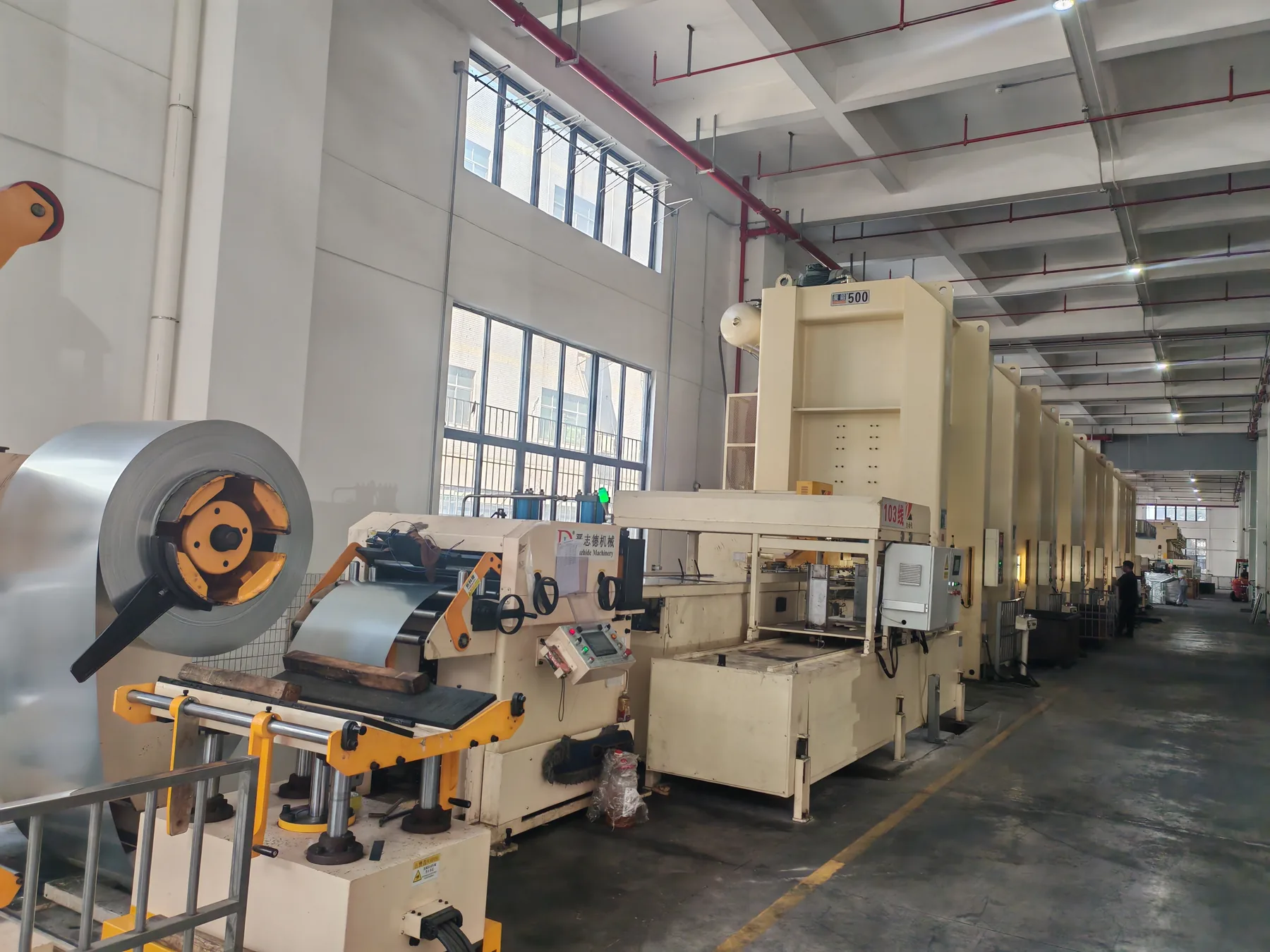
The cover shows a coil and stamping line in supplied company materials. It does not evidence material utilization, a rate or a quotation. The route comparison is hypothetical, and every cost model must be built from the actual drawing, process, volume and commercial terms.